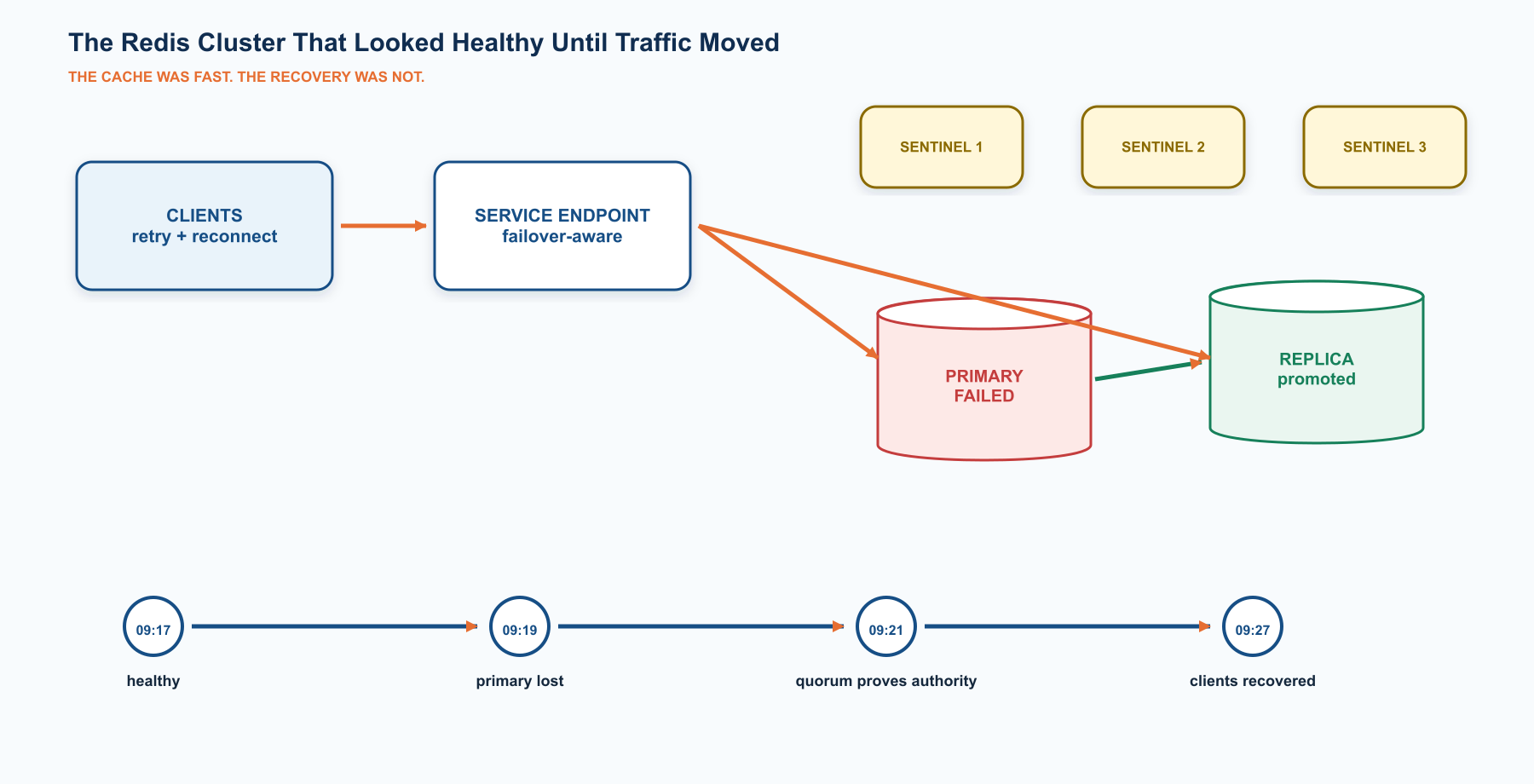
The Redis Cluster That Looked Healthy Until Traffic Moved
A field story about turning a familiar cache into a service that operators can actually recover.
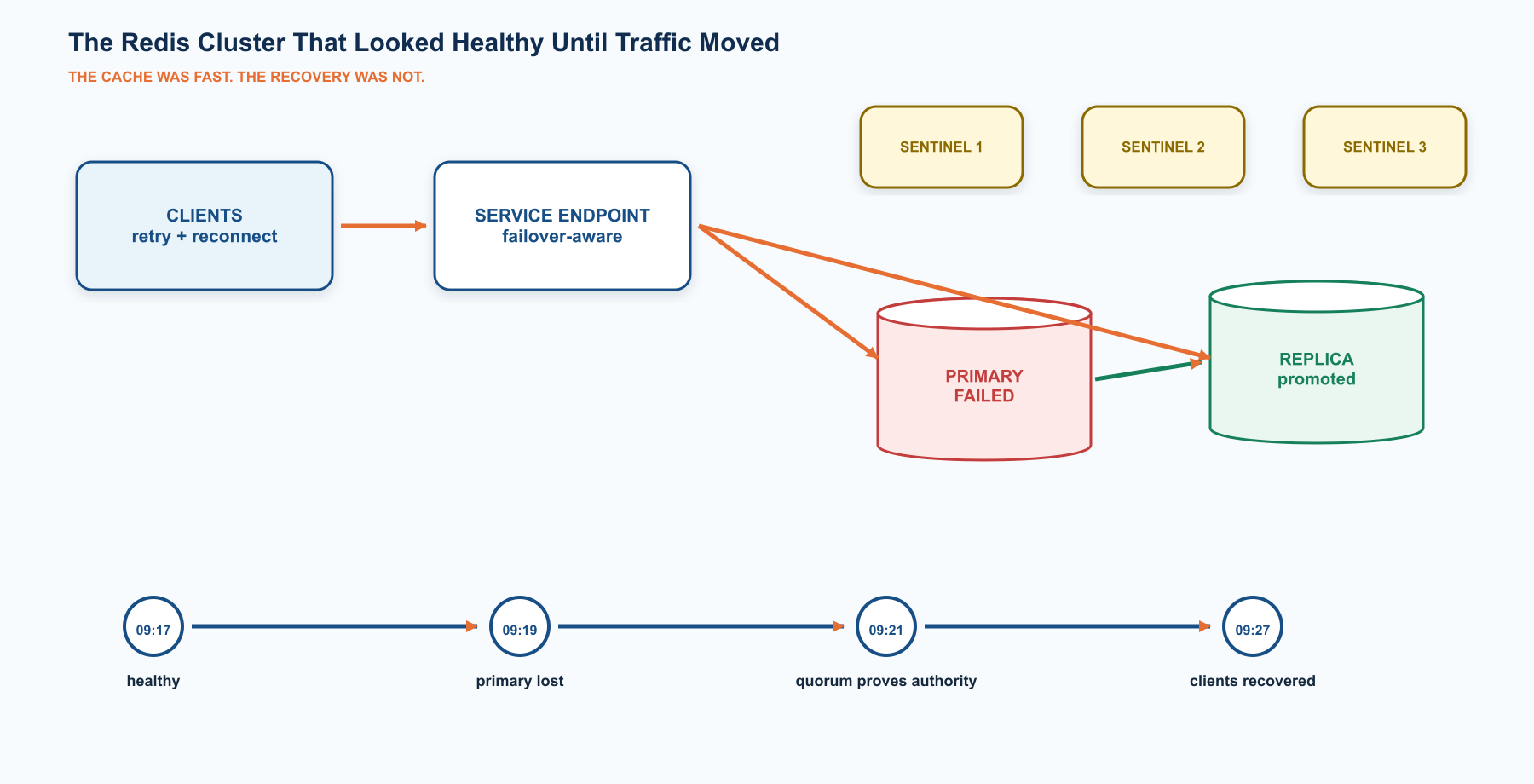
At 09:17 the dashboard was green. At 09:19 one Redis primary disappeared, clients began reconnecting, and the team discovered that 'high availability' had never been rehearsed under real traffic.
Start with one workload | Scale into a complete platform | Open Source Freedom | Enterprise-Grade Operations.
Published | August 2026
The moment the service stopped being simple
At 09:17 the dashboard was green. At 09:19 one Redis primary disappeared, clients began reconnecting, and the team discovered that 'high availability' had never been rehearsed under real traffic.
Nothing was fundamentally wrong with Redis. The problem was the operating model around it: different configurations on each host, a Sentinel quorum nobody had tested, and no shared answer to a simple question: which copy should the application trust now?
| The Cache Was Fast. The Recovery Was Not. |
The turning point
The team stopped treating Redis as three processes and started treating it as one declared service. Topology, persistence, identities, failover checks and recovery evidence moved into the same change path.
The team used OSS Manager to make governed Redis lifecycle and day-two operations reviewable and repeatable. The engine still owned its native behaviour; the control plane made intent, prerequisites, execution and evidence visible to the people responsible for the service.
What had to become explicit
- The service boundary: OSS Manager controls declared standalone, Sentinel, or cluster topology while preserving Redis-native replication, persistence, failover, ACL, and application semantics.
- The operational controls: version and topology validation, protected credentials, persistence policy, memory headroom, failover tests, backup evidence, and guarded lifecycle commands.
- The capacity conversation: peak commands per second, key count, value size, working set, TTL distribution, persistence overhead, replica count, failover headroom, and network latency.
- The human boundary: who may observe, who may approve, who may execute, and who decides whether the application is ready.
The architecture that changed the conversation
The diagram is deliberately centred on the decision the team had to make. It is not a product inventory. It shows where authority sits, what crosses the boundary, and where a failed assumption must stop the workflow.
The practical design choices
- Before change. Old response: Trust host scripts. Governed response: Plan topology and validate quorum.
- During failure. Old response: Restart until green. Governed response: Protect authority and observe replication.
- After recovery. Old response: Close the incident. Governed response: Retain evidence and rehearse again.
- Before approval. Old response: Assume failover is safe. Governed response: Prove client discovery, fencing and persistence.
- Before closure. Old response: Check only process health. Governed response: Validate data authority and application recovery.
These choices are intentionally small enough to review and test. They keep the architecture tied to operating behaviour instead of allowing a visually impressive diagram to hide unclear ownership.
What OSS Manager changed - and what it did not
OSS Manager brought discovery, planning, guarded execution and normalised status into one path for Redis. It did not replace the engine's correctness model or the application's responsibility for data semantics.
- Before change, validate versions, hosts, identities, artifacts, topology and the recovery boundary without mutating the service.
- During change, persist progress, expose stop conditions and prevent a partial result from being mistaken for success.
- After change, observe availability; command latency; memory fragmentation; evictions; replication offset; persistence status; failover state; rejected connections and run representative application journeys, not only process checks.
- For recovery, protect the last known-good authority and require an explicit decision before promotion, rollback or destructive cleanup.
The failure modes worth rehearsing
The test plan should make room for memory exhaustion, eviction-policy mismatch, replica lag, split authority, failed Sentinel quorum, AOF rewrite pressure, and client reconnect storms. The purpose is not to produce a longer checklist. It is to learn whether operators can recognise the failure and choose the safe next action while the evidence is incomplete.
A human operating model
L1 operators need a plain-language answer to what is healthy, what is delayed and whether a change is in progress. Platform engineers need topology and evidence. Application owners need to know what users will experience. A useful platform connects those views without giving every person the same privileges.
| The lasting improvement was not a faster failover command. It was a calmer room: L1 could see the state, platform engineers could explain the next step, and application owners knew exactly how clients would reconnect. |
Where this pattern earns its place
BFSI
This pattern is relevant where teams need controlled change, explicit authority, auditable recovery and customer-journey validation. The architecture must still be adjusted for local data classification, recovery objectives, workload shape and application behaviour.
Media and OTT
This pattern is relevant where teams need regional continuity, burst traffic, low-latency serving and predictable recovery. The architecture must still be adjusted for local data classification, recovery objectives, workload shape and application behaviour.
Retail
This pattern is relevant where teams need campaign peaks, catalogue freshness, transaction continuity and rapid rollback. The architecture must still be adjusted for local data classification, recovery objectives, workload shape and application behaviour.
The lesson we would carry into the next project
The lasting improvement was not a faster failover command. It was a calmer room: L1 could see the state, platform engineers could explain the next step, and application owners knew exactly how clients would reconnect.
The strongest open-source platforms are not the ones with the most automation. They are the ones where automation makes ownership, risk and recovery easier for people to understand.
| Start with one workload. Prove the operating model. Then scale it into a complete platform. |
