EVENT STREAMING
A Day in the Life of a Kafka Platform Team After the First Hundred Topics
Why partition health, controller quorum and application contracts must be operated as one system.
At ten topics, the platform team knew every producer. At one hundred, a routine broker restart could expose a weak replication factor, a noisy consumer, a full disk and a certificate nearing expiry in the same maintenance window.
Start with one workload | Scale into a complete platform | Open Source Freedom | Enterprise-Grade Operations.
Published | May 2026
Growth changes the questions
At ten topics, the platform team knew every producer. At one hundred, a routine broker restart could expose a weak replication factor, a noisy consumer, a full disk and a certificate nearing expiry in the same maintenance window.
The cluster could be technically available while the business stream was not. A green broker count did not answer whether partitions were online, consumers were catching up, or a rolling operation was still safe.
| Kafka Incidents Rarely Begin With Kafka Alone. |
The turning point
The operating model moved from host automation to workload-aware gates: quorum first, partition safety next, consumer impact visible, and every rolling step able to stop.
The team used OSS Manager to make governed Kafka KRaft platform operations reviewable and repeatable. The engine still owned its native behaviour; the control plane made intent, prerequisites, execution and evidence visible to the people responsible for the service.
What had to become explicit
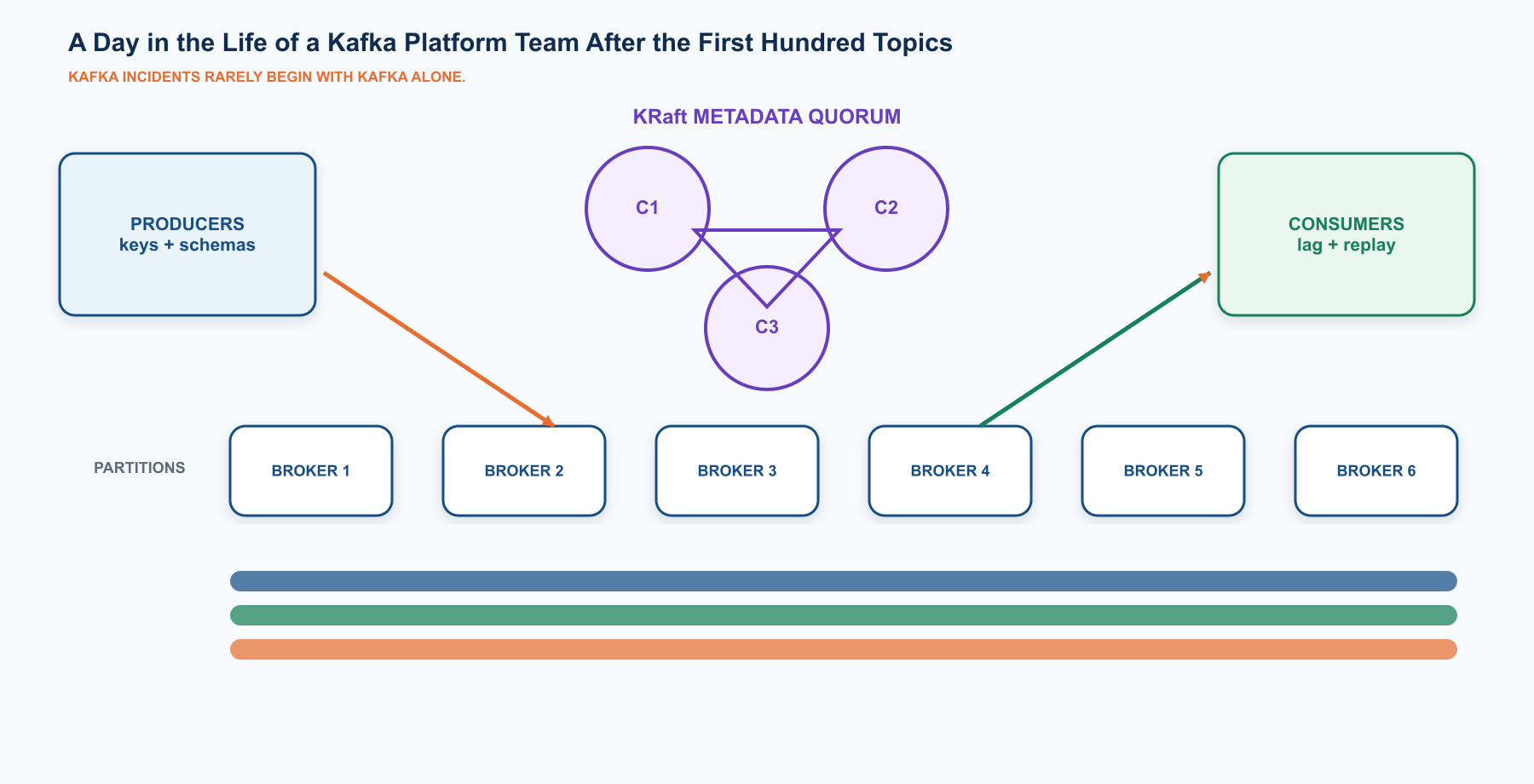
- The service boundary: A KRaft controller quorum and broker fleet are declared with rack awareness, TLS, ACLs, monitoring, storage policy, and controlled rolling operations.
- The operational controls: quorum sizing, rack placement, replication factor, minimum in-sync replicas, listener validation, rolling safety, ACL separation, and partition health.
- The capacity conversation: ingress and egress throughput, retention, partitions, replication factor, message size, consumer fan-out, recovery bandwidth, and disk headroom.
- The human boundary: who may observe, who may approve, who may execute, and who decides whether the application is ready.
The architecture that changed the conversation
The diagram is deliberately centred on the decision the team had to make. It is not a product inventory. It shows where authority sits, what crosses the boundary, and where a failed assumption must stop the workflow.
The practical design choices
- Under-replicated partitions. What it reveals: Reduced failure margin. Decision: Hold rolling change.
- Consumer lag. What it reveals: Business processing delay. Decision: Protect recovery bandwidth.
- Disk watermark. What it reveals: Retention and restart risk. Decision: Add capacity or reduce pressure.
- Controller quorum. What it reveals: Metadata authority is at risk. Decision: Restore majority before lifecycle work.
- Certificate horizon. What it reveals: Clients may fail together. Decision: Rotate and validate before expiry.
These choices are intentionally small enough to review and test. They keep the architecture tied to operating behaviour instead of allowing a visually impressive diagram to hide unclear ownership.
What OSS Manager changed - and what it did not
OSS Manager brought discovery, planning, guarded execution and normalised status into one path for Apache Kafka. It did not replace the engine's correctness model or the application's responsibility for data semantics.
- Before change, validate versions, hosts, identities, artifacts, topology and the recovery boundary without mutating the service.
- During change, persist progress, expose stop conditions and prevent a partial result from being mistaken for success.
- After change, observe controller quorum; broker health; under-replicated partitions; offline partitions; ISR changes; request latency; disk; consumer lag; rebalance rate and run representative application journeys, not only process checks.
- For recovery, protect the last known-good authority and require an explicit decision before promotion, rollback or destructive cleanup.
The failure modes worth rehearsing
The test plan should make room for controller loss, broker loss, ISR shrink, offline partition, disk watermark, certificate expiry, consumer rebalance storm, and unsafe rolling restart. The purpose is not to produce a longer checklist. It is to learn whether operators can recognise the failure and choose the safe next action while the evidence is incomplete.
A human operating model
L1 operators need a plain-language answer to what is healthy, what is delayed and whether a change is in progress. Platform engineers need topology and evidence. Application owners need to know what users will experience. A useful platform connects those views without giving every person the same privileges.
| Kafka became easier to run when the team stopped asking 'are the brokers up?' and started asking 'is the event service safe to change?'. |
Where this pattern earns its place
BFSI
This pattern is relevant where teams need controlled change, explicit authority, auditable recovery and customer-journey validation. The architecture must still be adjusted for local data classification, recovery objectives, workload shape and application behaviour.
Media and OTT
This pattern is relevant where teams need regional continuity, burst traffic, low-latency serving and predictable recovery. The architecture must still be adjusted for local data classification, recovery objectives, workload shape and application behaviour.
Retail
This pattern is relevant where teams need campaign peaks, catalogue freshness, transaction continuity and rapid rollback. The architecture must still be adjusted for local data classification, recovery objectives, workload shape and application behaviour.
The lesson we would carry into the next project
Kafka became easier to run when the team stopped asking 'are the brokers up?' and started asking 'is the event service safe to change?'.
The strongest open-source platforms are not the ones with the most automation. They are the ones where automation makes ownership, risk and recovery easier for people to understand.
| Start with one workload. Prove the operating model. Then scale it into a complete platform. |
